


In the past half year we had four PhD defenses. Underneath you can find a short summary of their PhD research here at CMM.
Congratulations again, Tom, Bernd, Siebe and Siddharth!
Tom Braeckevelt
Unraveling the Microscopic Origins of Phase Stability in Metal Halide Perovskites through Advanced Molecular Modeling – Friday March 6, 2026
Supervisors: Prof. Veronique Van Speybroeck and Prof. Johan Hofkens
Summary
Materials play a crucial role in the technological progress of our society. Metal halide perovskites are a promising class of materials for applications such as solar cells and LEDs, as they absorb light very efficiently, transport electrical charge effectively, and can be produced at low cost. However, these materials are often insufficiently stable and can transform into less functional forms under normal conditions.
I investigated why these materials are unstable and how their stability can be improved. To this end, experimental measurements are combined with advanced computer simulations that describe material behavior down to the level of individual atoms. A key breakthrough is the use of machine learning models based on neural networks, which significantly accelerate these simulations.
This research provides new insights into the origins of instability in perovskites and demonstrates how targeted modifications like mechanical strain or doping, can enhance their stability. The developed methods support the design of new, durable materials for future optoelectronic applications.
Bernd Schmidt
Modeling Transport Properties of C2 Species in Nanostructured Materials for Separation– Tuesday March 31, 2026
Supervisors: Prof. Veronique Van Speybroeck and Prof. Louis Vanduyfhuys

Summary
Understanding materials plays a crucial role in our highly advanced society. Zeolitic imidazolate frameworks (ZIFs) are a very promising class of materials for applications such as catalysis, sensing, and gas separation. However, for industrial applications, it is important to have an in-depth understanding of these materials to achieve the highest productivity.
This dissertation investigates the transport properties of C2 species in nanostructured materials for separation. For this, we use computational methods to model the movement of the guest molecule and investigate the impact of the host material on the guest molecule motion down to the atomic level. A major breakthrough in modeling is the use of machine learning models, based on neural networks, which allow a significant speed-up while keeping high accuracy.
This research offers new insights into the impact of ZIF-8 on ethane and ethene diffusion, with the decomposition method demonstrating the entropic hindrance of ethane and ethene diffusion imposed by the host material. The newly developed method supports the design and development of more applicationspecific materials for separation purposes.
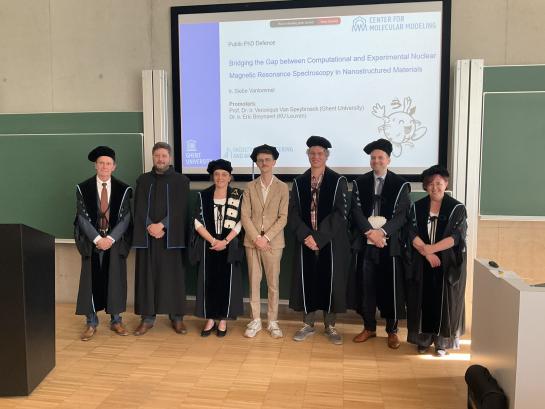
Siebe Vanlommel
Bridging the Gap between Computational and Experimental Nuclear Magnetic Resonance Spectroscopy in Nanostructured Materials – Monday June 29, 2026
Supervisors: Prof. dr. Veronique Van Speybroeck, dr. Eric Breynaert
Summary
The development of increasingly efficient catalysts requires an understanding of their structure at the atomic level. Nuclear magnetic resonance spectroscopy (NMR) is an important technique that offers atomistic insight without depending on long-range order. However, the computational simulation of NMR properties has been developed insufficiently. This dissertation aims to bridge the gap between experimental and computational NMR spectroscopy in nanostructured materials, wherein disorder, dynamics and interactions with adsorbates complicate NMR spectral interpretation. The work develops NMR modelling strategies to increase the reliability of spectral simulation by employing a set of benchmark materials of increasing complexity, thereby contributing to a quantitative, atomistic understanding of catalytically relevant materials.
Siddharth Ravichandran
Towards Accurate, Efficient, and Reproducible Computational Modeling of Adsorption in Nanoporous Materials – Tuesday June 30, 2026

Supervisors: Prof. Veronique Van Speybroeck, Prof. Louis Vanduyfhuys
Summary
Nanoporous materials are a promising class of porous systems whose internal pores can selectively adsorb gas molecules from a mixture. This makes them highly relevant for gas storage and separation applications. Designing better materials requires knowing exactly how gas molecules behave inside these pores, but simulations of adsorption are simultaneously challenged by accuracy, efficiency, and reproducibility. Addressing all three within a single computational framework remains an open problem. This dissertation develops strategies that tackle each challenge, making simulations more accurate without becoming prohibitively expensive, and ensuring results can be shared and verified across the scientific community. The outcome is a more trustworthy computational foundation for the design of nanoporous materials for energy and environmental applications.