K. De Wispelaere
Complete low-barrier side-chain route for olefin formation during methanol conversion in H-SAPO-34
Unraveling the Reaction Mechanisms Governing Methanolto-Olefins Catalysis by Theory and Experiment

Abstract
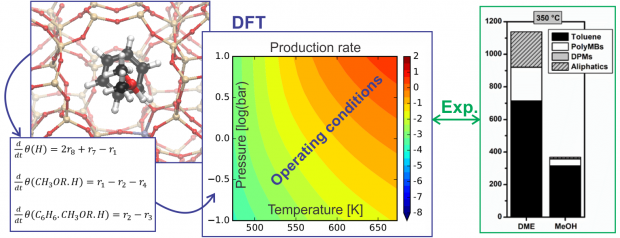
The conversion of methanol to olefins (MTO) over a heterogeneous nanoporous catalyst material is a highly complex process involving a cascade of elementary reactions. The elucidation of the reaction mechanisms leading to either the desired production of ethene and/or propene or undesired deactivation has challenged researchers for many decades. Clearly, catalyst choice, in particular topology and acidity, as well as the specific process conditions determine the overall MTO activity and selectivity; however, the subtle balances between these factors remain not fully understood. In this review, an overview of proposed reaction mechanisms for the MTO process is given, focusing on the archetypal MTO catalysts, H-ZSM-5 and H-SAPO-34. The presence of organic species, that is, the so-called hydrocarbon pool, in the inorganic framework forms the starting point for the majority of the mechanistic routes. The combination of theory and experiment enables a detailed description of reaction mechanisms and corresponding reaction intermediates. The identification of such intermediates occurs by different spectroscopic techniques, for which theory and experiment also complement each other. Depending on the catalyst topology, reaction mechanisms proposed thus far involve aromatic or aliphatic intermediates. Ab initio simulations taking into account the zeolitic environment can nowadays be used to obtain reliable reaction barriers and chemical kinetics of individual reactions. As a result, computational chemistry and by extension computational spectroscopy have matured to the level at which reliable theoretical data can be obtained, supplying information that is very hard to acquire experimentally. Special emphasis is given to theoretical developments that open new perspectives and possibilities that aid to unravel a process as complex as methanol conversion over an acidic porous material.
Experimental and theoretical IR study of methanol and ethanol conversion over H-SAPO-34

Abstract
Theoretical and experimental IR data are combined to gain insight into the methanol and ethanol conversion over an acidic H-SAPO-34 catalyst. The theoretical simulations use a large finite cluster and the initial physisorption energy of both alcohols is calculated. Dispersive contributions turn out to be vital and ethanol adsorbs stronger than methanol with approximately 14 kJ mol(-1). Calculated IR spectra of the alcohols and of formed aromatic cations upon conversion are also analyzed and support the peak assignment of the experimental in situ DRIFT spectra, in particular for the C-H and C=C regions. Theoretical IR spectra of the gas phase compounds are compared with those of the molecules loaded in a SAPO cluster and the observed shifts of the peak positions are discussed. To get a better understanding of these framework-guest interactions, a new theoretical procedure is proposed based on a normal mode analysis. A cumulative overlap function is defined and enables the characterization of individual peaks as well as induced frequency shifts upon adsorption. (C) 2010 Elsevier B. V. All rights reserved.
Open Access version available at UGent repositoryMechanistic Studies on Chabazite-Type Methanol-to-Olefin Catalysts: Insights from Time-Resolved UV/Vis Microspectroscopy Combined with Theoretical Simulations

Abstract
The formation and nature of active sites for methanol conversion over solid acid catalyst materials are studied by using a unique combined spectroscopic and theoretical approach. A working catalyst for the methanol-to-olefin conversion has a hybrid organic–inorganic nature in which a cocatalytic organic species is trapped in zeolite pores. As a case study, microporous materials with the chabazite topology, namely, H-SAPO-34 and H-SSZ-13, are considered with trapped (poly)aromatic species. First-principle rate calculations on methylation reactions and in situ UV/Vis spectroscopy measurements are performed. The theoretical results show that the structure of the organic compound and zeolite composition determine the methylation rates: 1) the rate increases by 6 orders of magnitude if more methyl groups are added on benzenic species, 2) transition state selectivity occurs for organic species with more than one aromatic core and bearing more than three methyl groups, 3) methylation rates for H-SSZ-13 are approximately 3 orders of magnitude higher than on H-SAPO-34 owing to its higher acidity. The formation of (poly)aromatic cationic compounds can be followed by using in situ UV/Vis spectroscopy because these species yield characteristic absorption bands in the visible region of the spectrum. We have monitored the growth of characteristic peaks and derived activation energies of formation for various sets of (poly)aromatic compounds trapped in the zeolite host. The formation–activation barriers deduced by using UV/Vis microspectroscopy correlate well with the activation energies for the methylation of the benzenic species and the lower methylated naphthalenic species. This study shows that a fundamental insight at the molecular level can be obtained by using a combined in situ spectroscopic and theoretical approach for a complex catalyst of industrial relevance.